
How ATP Actually Fuels Your Body (Or: Why Creatine?)
At the most basic level, your body runs on a molecule called ATP (adenosine tri-phosphate). It’s your body’s immediate-use energy source.
Every single muscle contraction that your body makes, no matter what you’re doing—requires ATP, because ATP IS THE ONLY ENERGY SOURCE MUSCLES CAN USE!
So, when your body needs to move, it breaks one of ATP’s chemical bonds to release its potential. That splits off one bond out of three (it’s a tri-phosphate), leaving it with two (a di-phosphate). Now, before that di-phosphate can be useful again, it needs to grab a free phosphate to return itself to its original tri-phosphate state.
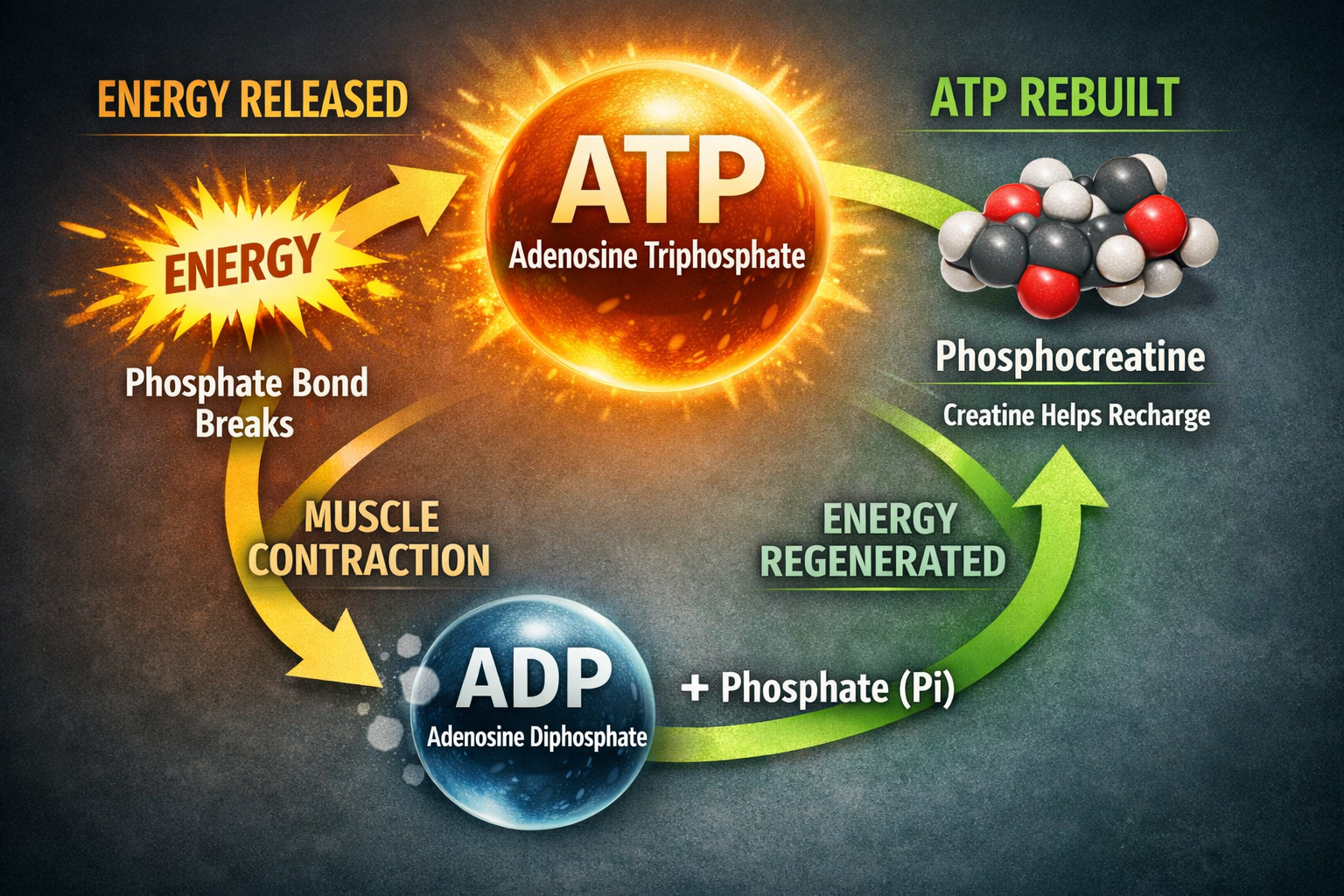
That’s why the creatine replacement works: your muscle calls for energy to contract, the molecule breaks the bond and provides the energy, then immediately grabs a phosphate. This continues until there are no more free phosphates, causing your muscle to fatigue and ultimately fail. You have to either slow down or stop to let that energy recharge. Our bodies don’t store much ATP. It takes only a few seconds at any given time, and it depletes very quickly. If you’re doing anything remotely intense or sustained for any amount of time, your body has to constantly create more ATP on the fly, while you’re moving.
One of the fastest ways your body does that is through a system that uses phosphocreatine—which is when you’ll benefit if you’ve got creatine supplementation in your system.
Creatine: The Benefits
If you’re serious about working out and making the most of your time spent dedicated to exercise, creatine is one of the simplest, most effective, best-studied, and most affordable tools available.
It helps you produce energy faster when you need it the most
Creatine supports rapid ATP regeneration during high-effort work: strength training, intervals, anything explosive.It improves training quality
This isn’t magic—it just helps you get that little bit more: an extra rep, a bit more weight, slightly better output. Over time, that’s what drives real progress.It keeps muscles ready to grow
Creatine not only lets you get in another rep, it also helps to support muscle health with muscle cell hydration, playing a key role in recovery and growth.It can help offset age-related decline
As people enter their 40s, 50s, and beyond, maintaining muscle becomes more important—and more difficult. You have to work just as hard or harder to get the results you used to as you age. Creatine can help support that process.It’s not just for muscles
Your brain is a muscle, and about 20% of your daily energy expenditure is consumed by brain activity, so your brain also relies on ATP. There’s increasing evidence that creatine may help with mental performance, especially under fatigue or stress.
Is It Safe??
Creatine monohydrate is one of the most researched supplements we have and is generally considered safe for healthy individuals when used appropriately. As always, anyone with underlying medical conditions or considering unusually high intake should check in with a qualified healthcare provider first.
If you’re putting in the work but not seeing the progress you expect, it’s not always just about trying harder—sometimes it’s about using the right tools and having a plan that actually fits you.
That’s exactly what we focus on.
If you’re ready to get started, click below and book a free consultation so we can talk about goals and get you the right tools to get started!